Showing posts with label mentor. Show all posts

Tuesday, November 27, 2012

GREAT WORK - You did the bare minimum!!

Somehow, somewhere along the line it has become a custom in our society to expect praise for simply following expectations. "Aren't you proud of me Miss? I have a pass to be in the hallway!" "Look at the medal I got because my mom signed me up for sports and took me to the games!" "You passed the assessment because you got 1/2 the questions right!" I mean we all like to be praised. Who doesn't like it when we're told how fantastic we are? Or that someone is proud of us? But at what point does it become pushing everyone to the middle? When I was a kid I was so proud of my medals and trophies that had a place value on them (1st, 2nd, etc) but I also distinctly remember throwing them out as I got older if they said something along the lines of "Certificate of Participation." Well I KNOW I participated - I was THERE! My daughter (whom I love and adore and have clearly somehow raised her to display the following behavior) said to me the other day "Hey I'm on time. Aren't you proud of me? Can I have a (fill in the blank with random teen-aged stuff) because I came home on time?" My reply of course was "Uh no, you CAN continue to have normal PRIVILEGES though because you were on time tonight. I love you!" Now don't get me wrong, when she does something that blows my mind, I let her know just how amazing she is. Such as when she made the talent show and sang so beautifully it made me cry, I told her that it was so beautiful I cried and that I think she's completely fantastic. Or when she lettered as a freshman at a 6A high school in Cross Country, I rushed out to buy the letter jacket and sewed the letter on it myself. But it seems that we (as a society) have come to expect things to be given to us simply because we show up. There are a number of professions where people actively petition against work evaluations or merit-based pay, yet many of these same people expect a yearly raise simply for coming to work on a regular basis. I just don't understand. 

I distinctly remember receiving a state reading assessment score in elementary school and asking my mom what the 90+ percentile meant. She smiled at me, told me she was proud of me and explained "That means if 100 people lined up in order of their scores, you'd be ahead of more than 90 of them in line." I remember that because I had worked really hard on that test and was incredibly proud of my achievement - not because I happen to just show up and do the minimum. On the opposite end of that spectrum, I remember coming in WAY past curfew one night and being told I would be "volunteering" with my sister's cheer squad at a fireworks stand the whole rest of the 4th of July weekend instead of hanging out with my friends like I had planned. My parents set very clear standards for my behavior and I knew that it was my responsibility to follow these standards. If I did something above and beyond the minimum, I was praised and I enjoyed that because it was heartfelt praise and I knew my parents were genuinely proud of me. If I failed to meet the minimum standard, I knew negative consequences were appropriately headed my way. Perhaps this type of upbringing is what has made me the matter-of-fact, outspoken person I am that can sometimes be "a bit too much" for some folks to handle. And I know it's made me the kind of person that would be a less-than-adequate preschool and elementary school teacher. But it's also this same upbringing that gave me the drive to finish high school even though I made the poor choice to become pregnant at 17, complete my bachelor's degree while working full-time to raise that young child, obtain a master's degree while working full-time and continue to work hard to further my career success.  I've learned through these life experiences that I enjoy a challenge and the feeling of personal accomplishment that comes with meeting a challenge head on and conquering it. Is that so bad? Do we not wish our children have better lives than we have? Do we not want our children to work hard so THEIR kids can have better lives than they have? If we continue to tell people "Great work!" simply for showing up, or "You're amazing!" because they've met the bare minimum, where will our society be when my kids are my age? Or my parents' age? I don't know the answers to these questions, but I don't really have a great feeling about it...

Image courtesy of http://www.fotopedia.com. 


Thursday, August 16, 2012

Seeing the Final Product

Well I've "moved up" to high school this year as a data leader, which means I help staff members use classroom and assessment data to drive instruction (that's the hope anyway.) I have always worked in middle school so I've never been able to see "the end product" with my students. Until this year that is. I am at the high school right next door to the middle school where I had my first teaching job and this year's seniors are my last group of sixth graders from "across the lot." It has been very exciting for me to see so many of my former students these last few days and sad to see many of them not here because they have already decided school isn't "the way to go." When I taught "across the lot" I had all of the ESOL students as soon as they left the Newcomers' program. I have been impressed and awed by the development of so many of my former students' language skills - they ROCK! I've been really surprised and flattered by the number of students that not only remember my name but also have memories from my class that they've been wanting to tell me. These are SENIORS people and that was six years ago, which in "teen-aged years" is practically a lifetime! 
Some of my favorites have been memories of the hissing cockroaches I had in my classroom, the time that a student tried to pull the tail off of my leopard gecko, how much they loved "Science in a Box" days, using technology in class "almost every day" and various memories of my former partner teacher and I goofing off in the hallways. One story in particular stuck with me. A little girl that spoke very basic English in 6th grade (Vietnamese is her native language) walked up to me in the hallway and said "I remember you. You were my very first science teacher in the United States and your class was so interesting. You had those hissing bugs and gross lizards, but I loved your class anyway because we got to do the work with our hands, which helped because I didn't speak English very well yet. And my friends from that class were just talking the other day about how you said that when you got your diploma book at graduation there was a problem and no one got their diplomas that year. You had to go back to the school later to get them. Some of my friends are wondering if the same thing is going to happen to us. We think that would be funny if it did!" It was such a small story that I told to my students yet six years later there is a small group of students that remembers it. It's astounds me everyday the connections we make with our students and the impact on their lives we have. I don't know why they remembered that particular story, but it made me feel so very important that they would pay attention to such a little thing like that and reminds me again of the important role we as educators play in our students' lives. 
So with this in mind, remember that your students really are listening when you speak and that you play a HUGE role in their lives - both educationally and otherwise. 

Photo courtesy of iStock

Friday, October 23, 2009

Please Step Away from the Textbook!


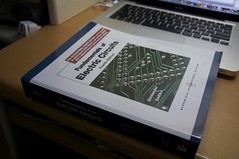
Textbooks are a staple in most classrooms and can be a great resource for teachers. The problem I find (not that I am even close to the first person to realize this) is that a large number of teachers use their textbook and accompanying teacher's guide as the ONLY resource for teaching. This is prominent from kindergarten all the way to post-secondary education. The problem with this is that teaching from the textbook shuts the door in the faces of students and locks them into their classrooms. Our world holds so many resources for educators - all we have to do is open our eyes and minds and look for them. 

Students today are collaborative, communicate with their peers on a highly frequent basis, create, explore, adapt, and design - except when they are in school. Often times when students enter school they are asked to “power down” their phones, computers, and themselves. On their own, students use technology to explore their world and communicate with others. But in their classrooms, many times the option to use those tools is not available to them. In a large portion of these classrooms, the reason isn’t a lack of access, but rather teachers simply aren’t allowing the students to use the tools available to them.  This lack of use is usually born out of one thing - fear. A fear that the technology may not work properly, a fear that things may not "go as planned," a fear that the students might abuse the technology, and probably mostly a fear of not being the expert in front of students. While it is okay to be afraid, it is not acceptable to allow that fear to prevent you from creating a more appropriate learning environment for students. Even if nothing works they way you plan and the students end up having to show you how to use the tools, the learning that will occur in that time will be completely worth it. The experience may even allow you to see strengths in your students that you may have never before seen.


If you are reading this post you are probably not tied to your textbook, but I'm willing to bet that you know someone that is. So why not offer up a few ideas to that person that will help them expand a learning environment beyond their classroom walls, or at least beyond the covers of the textbook? Introduce someone to the power of the internet for not only creating more engaging learning environment, but also as a way to extend their own learning network. If you're just starting to explore your options outside of your textbook, seek out another person to either explore with you or someone who could act as a mentor and guide in your journey. Trust me, whether you enter the partnership as a guide or "student" you will find yourself learning from the experience and eager to do more learning and exploring.


A couple of days ago someone on Twitter posted a link to David Warlick's article If you can't use technology get out of teaching! which inspired this post, so thanks to my PLN in Twitter (and David Warlick of course.)

Image courtesy of  joewhk and Flickr.