I have a confession to make...
I failed the second semester of my junior year of high school.
I had chosen Ralph Waldo Emerson as a topic for my junior research paper, which was the majority of the semester's grade. I painstakingly created 25 note cards documenting my research and wrote my rough and final drafts. But when it cam time to turn in my paper, I had lost my note cards. And since I have been a procrastinator since birth, I didn't complete the assignment until the night before it was due. This meant that I didn't have time to re-make those note cards and received an F on my research paper and an F for the semester.
To this day I have no idea what I learned from that experience. As I am scouring my action research paper for APA errors, I am having flashbacks to that time of failure in my life. I still wonder why it wasn't enough she had already given me the points for completing the note cards on time earlier in the semester. I don't know if I ever told my parents the real reason I failed that assignment. I don't even remember if I had enough guts to ask for extended time to create a new set. I wonder now as I did then, what the educational value failing a student for losing a stack of cards was. I still enjoy Emerson's work and remember some of what I had learned from the research. But what I remember most is crying while digging through my closet, locker and car looking for those cards because I knew that without them I would fail.
So I guess I did learn from that experience, although it wasn't what my teacher had intended. I still lose paper almost as soon as I put it down (so thank goodness I can take notes on my laptop.) And I still have no idea how to properly document my resources in MLA or APA. What I learned was that was one thing that I never wanted to do to my students, even though at the time I didn't know I was going to be an educator. All I knew was that I never wanted to another person to feel the way I had because of something I had done.
Image courtesy of Wikimedia Commons.
Showing posts with label pedagogy. Show all posts
Friday, December 11, 2009
Tuesday, November 3, 2009
What's the "Right Answer"?
This morning I read a post on David Freeburg's blog Epic Epoch about differentiating and his thoughts about whether the process or the product was the most important component of the learning experience. This of course got me thinking about our students today. One of the comments left was that his students are more concerned about getting the "right answer" than they are learning from the process. But how did they get that way? Are we born that way? Or have years of education where you must have the correct answers on the test in order to pass made students that way? I've even been in professional development sessions where teachers have asked "You've shown us a lot of ways to teach this concept. Which is the best way?" That to me leads me to think that the problem is not with students, but that the problem is with the system.
If you give a group of primary aged students some "crafts" supplies and tell them to build a model of a house, they'll dive right in and start building. They won't even think about how their teacher thinks it should look nor will they worry about "right way" to build it. They'll simply dump the supplies out and start working to build a house. But, if you give those same supplies to a secondary level student and tell them to build a model of a house, it is almost guaranteed that they'll start asking questions. "How many points is this worth?" "How big does it have to be?" "Is there an example I can look at so I can get it right?" What happens between those early elementary years and middle school that students are becoming disconnected from the fun of learning? Even further, what will happen to those same students when a grade is no longer attached to a product? As educators we need to recognize the fact that learning is much more than "getting the right answer." It is about learning to learn. If we as educators do not start to focus on the process, students won't either and we'll have no one to blame but ourselves when our students fail. We've got to acknowledge that we are the ones that need to implement change, and only when that happens will our students' enthusiasm for learning grow. Only then will our students truly become life-long learners.
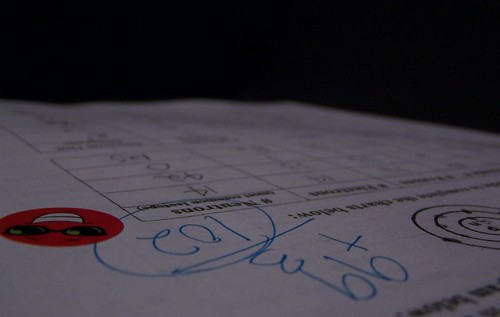
Image courtesy of Flickr and jason03yingling.
Labels:
21st century learning,
education,
paradigm shift,
pedagogy,
teaching
Subscribe to:
Posts (Atom)