Friday, October 23, 2009

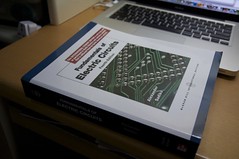
Please Step Away from the Textbook!


Textbooks are a staple in most classrooms and can be a great resource for teachers. The problem I find (not that I am even close to the first person to realize this) is that a large number of teachers use their textbook and accompanying teacher's guide as the ONLY resource for teaching. This is prominent from kindergarten all the way to post-secondary education. The problem with this is that teaching from the textbook shuts the door in the faces of students and locks them into their classrooms. Our world holds so many resources for educators - all we have to do is open our eyes and minds and look for them. 

Students today are collaborative, communicate with their peers on a highly frequent basis, create, explore, adapt, and design - except when they are in school. Often times when students enter school they are asked to “power down” their phones, computers, and themselves. On their own, students use technology to explore their world and communicate with others. But in their classrooms, many times the option to use those tools is not available to them. In a large portion of these classrooms, the reason isn’t a lack of access, but rather teachers simply aren’t allowing the students to use the tools available to them.  This lack of use is usually born out of one thing - fear. A fear that the technology may not work properly, a fear that things may not "go as planned," a fear that the students might abuse the technology, and probably mostly a fear of not being the expert in front of students. While it is okay to be afraid, it is not acceptable to allow that fear to prevent you from creating a more appropriate learning environment for students. Even if nothing works they way you plan and the students end up having to show you how to use the tools, the learning that will occur in that time will be completely worth it. The experience may even allow you to see strengths in your students that you may have never before seen.


If you are reading this post you are probably not tied to your textbook, but I'm willing to bet that you know someone that is. So why not offer up a few ideas to that person that will help them expand a learning environment beyond their classroom walls, or at least beyond the covers of the textbook? Introduce someone to the power of the internet for not only creating more engaging learning environment, but also as a way to extend their own learning network. If you're just starting to explore your options outside of your textbook, seek out another person to either explore with you or someone who could act as a mentor and guide in your journey. Trust me, whether you enter the partnership as a guide or "student" you will find yourself learning from the experience and eager to do more learning and exploring.


A couple of days ago someone on Twitter posted a link to David Warlick's article If you can't use technology get out of teaching! which inspired this post, so thanks to my PLN in Twitter (and David Warlick of course.)

Image courtesy of  joewhk and Flickr.

Tuesday, October 6, 2009

Exciting New Opportunity


Well I'm very excited about a new project that I've been able to undertake this semester. I have the privilege to be able work with a local middle school's instructional coaches to not only embed technology use into their weekly professional development sessions, but also to add technology integration ideas into their actually delivery to the teachers. Meaning for every topic and concept they're covering in PD this semester, I'm going to add ways to embed technology into specific curricular areas. I'm very excited about this because this school already has a good amount of technology in the classrooms, but the teachers still aren't using the tools to their potential - some aren't even using them at all. In my experiences, there is a large portion of the educator population that will embed technology and 21st century skills into their instruction if they are simply taught the skills to do so. Most technology PD is simply teaching participants how to use the tool. I firmly believe that if you follow that instruction will curriculum specific ways to integrate the tools and skills teachers are much more likely to do so.

I have also offered to the entire staff to personally come into their classrooms and help them plan technology rich instructional units, help them deliver the lessons, or even to teach a lesson their classroom. I really feel that most educators would are willing to integrate more technology into their instruction, thereby greatly enriching their students' learning environments, but they are simply not equipped with the skills to do so or afraid that "things might not go right." It is my hope that by giving them the skills and impressing upon them the importance of allowing the students to lead the way (even if things to always go according to plan) that their students' engagement and achievement will increase. When this happens the job of being the teacher becomes less "work" and more of a learning experience for everyone involved.

Image courtesy of tinaylin and Flickr

Sunday, August 30, 2009

What Are We Blocking?

Our district, like most, has an Internet filter and guidelines for what gets filtered. And, like most educators that work in districts with filters, I hit that filter a minimum of once a day, most days it much more than that if I'm reading and researching. There are a number of sites that I use as an educator and technology specialist professionally that are blocked within our district, Twitter being the most frustrating block for me (although I do find access to it through a couple of widgets). I use Twitter as a professional in a number of ways, from learning from others, to share my learning, as well as the occasional "Help, I'm looking for _____ resources." And my Twitter network never fails to deliver when I need it. The latest frustration is with image sharing sites. We've got a large number of teachers starting to implement blogging into their classrooms and are wanting to use a template from the Internet. The problem is that the images for those templates are hosted on image sharing sites that are blocked in the district, which means the templates can't be properly viewed within the district. The worst part is that teachers and students have the same filtering levels, so teachers don't even have the ability to evaluate a website for classroom appropriateness if it does happen to be blocked for the students.

I understand the concept for blocking, that we're keeping students from viewing inappropriate content and materials. But I am often left wondering what we're really teaching students (and teachers) when we block so much of the Internet. How can we fully teach Internet safety if we block so much of its content? How can we convince teachers that we trust their judgement to select appropriate resources and content for their classrooms if they have to rely on someone else to evaluate whether or not a site should be blocked? How can we teach our students to collaborate in our global society if we block so many of the social networking and media sites that exist today? These are questions that are often spinning around in my head.

I read about others using social networking, media, and bookmarking sites all the time in their classrooms and district, but as we not only filter but do not supply our students with email addresses OR allow them to use their personal emails, we are not able to use a large number of these tools as they are intended. As I'm not in a position to actually make the decisions as to what types of access students have, I often find myself spinning my wheels when I hit that filter searching for a tool to use in the classroom. Some day surely we will be able to give our students safe access to all of the tools that are available out there, and surely if we all keep trying and promoting the incredible advantages to the massive number of tools that are available to us on the Internet. Considering our students (and teachers) are using a large number of social networking and media sites at while they are at home, we won't have to spend much time teaching the tools. We'll actually be able to teach our students (and teachers) how to use these tools appropriately and how to harness their power in the classroom in order to become responsible citizens in today's global society.

Image thanks to Flickr and
epmd.

Thursday, August 27, 2009

Blurring the Lines

I am an Instructional Technology Specialist (ITS). It is my job to help teachers to integrate technology into their instruction in order to improve the learning experience for students. When I grappled with the decision of whether or not to leave the classroom I finally decided that I can impact the learning of far more students in this role and took the leap, and I truly love my job. I get the opportunity to lead PD sessions, co-teach lessons with other teachers, and offer one-on-one sessions all in the hopes that more students will be impacted by an improved and more appropriate learning environment.

All that being said, the line between "ITS" and "Help Desk" are often blurred. During my training sessions I hand out my card to anyone who wants it and offer my continued support for helping participants integrate technology into their instruction. But because I hand out my card so readily, I also get a number of calls from people wanting me to fix their computer or hardware. This is where the lines start to blur. Because I am fluent a number of software and internet applications, I have by default learned to trouble-shoot computers and a number of different types of hardware. So the teacher in me want to teach others how to trouble-shoot themselves so they don't have to make more pleas for help, but the ITS in me wants to tell people that it isn't my job to fix their computer and that they need to call their building's tech or the Help Desk. Of course I usually end up teaching them to fix it and then I end up getting more calls and emails for hardware issues.

Another reason the lines are blurred is because I manage the accounts, usernames, and a variety of other "technical support" types of functions for a variety of applications in the district. For example, because I am the website administrator/trainer for our district, I also inherited the job of managing the web server. This further leads people to call me to help them when they need both instructional and technical help with technology. And again, the teacher in me usually wins out and I end up teaching more people how to trouble-shoot and fix their hardware issues.

The reason I let my inner teacher come out in these instances is that I want the issues to be taken care of quickly so that the teachers can get back to teaching and the students can be more positively impacted.The fact is if they have to wait until their building tech can come check on their problem, the learning utilizing that tool will be put on hold and students will be negatively impacted. I also feel that the more teachers know how to do on their own for technical support, the more I will get to do on the instructional side of technology integration. I feel that if I just teach this teacher to be a little more confident in his/her abilities his/her comfort level with technology will increase and the integration will happen more readily. The problem is that there are just so many teachers out there and I get stuck in this vicious cycle that just seems to keep going around and around. The solution for now seems to be keep plowing forward and try to help as many people as possible.

Image courtesy of Flickr and
Philou.cn.

Wednesday, August 12, 2009

Glass Half-empty or Half-full?

In my job I run into a large number of nay-sayers, negative Nancys (or Neds), glass-half-empties, or whatever it is you call a person that always sees the flaws and defects in something first. You know them. When you show them how to use a blog as an online journal for their classroom, the first thing they say is "my kids can't use the internet at home" or "no way I can get into the lab enough to make it worth the work." As soon as you show them an internet-based alternative to the "Inspiration" software they don't have in their new school, they're pointing out how this tool only saves as an image so you can't edit it later. When you show them how to create student usernames and passwords for their wiki or content management system, they're upset because they already know their students won't be able to remember the password. You know them.
And as much as I try, this can at times be a drain on me, both emotionally and physically. Just this week I was at a school helping teachers learn to use their new SMART boards and the complaints came in mountains. The vast number of pre-made lessons available on our website weren't exactly how they wanted and they don't have the time to learn a new tool. "Does the board really have to be re-oriented every time I move the projector?" "I've had that table there for three years and now I have to move it because someone put this board in my room. That table won't work anywhere else in my room." And this is only about a SMART board. I don't even want to get into the conversations that happened when teachers found out that our contract with Blackboard isn't going to be extended and that they'd have to learn a new tool if they wanted to keep their content online.
I have come to realize that it is part of my job to keep smiling and holding hands so that teachers don't lose faith, so that teachers will keep trying new ideas, and so that classrooms can take yet another step to being student-centered learning environments. This is the most difficult and important part of my job and it wasn't even in the job description when I applied. So after a couple of years, I've stumbled across some concepts that seem to help me do this, the most important part of my job.
To begin, I always try to let "Nancy" know that her opinion is valid. Even if I think it is an imagined hurdle or fear, in that person's mind it is real and therefore I need to listen and validate it. I also need to make sure I stay positive while I'm listening and responding so that "Nancy" will see that there really is a light at the end of that tunnel. It also helps to be a quick thinker and problem solver so that when a teacher comes across a hurdle, I/we can quickly come up with a solution for getting over that hurdle. The next part is something that I personally have to work really hard at doing, and that is checking back frequently to make sure the solution is still working. I have found this one to be important because so many times if there is one bump in the new road for that teacher, that bump will keep him/her from traveling that road at all. But I have found that if I check back with individuals, it seems to keep the motivation up and that they will eventually feel comfortable enough that they can contact me without waiting for my emails. Finally, I have to be continually looking for new ideas and ways for teaching "old" concepts. This is because technology is changing so rapidly and new hurdles and bumps show up in the road every day. This one is probably one of the best parts of my job, as it means I get to spend time surfing the net and learning from my PLN which always leaves me inspired to do more.

And just in case you're wondering, here's a few suggestions for the problems presented above. For blogging nay-sayers: suggest that maybe at first try using the blog as an extra-credit opportunity for journals to see how many students truly don't have access to internet at home. For those upset that free mind-mapping tools don't often allow for changes and updates, point out some of the great online image editing tools that will allow for later "additions" so that teachers can demonstrate to students how the learning process is continually changing and growing. And for the teacher that's worried her students won't remember passwords, well this is one I still don't have a fantastic response for so if you have one - help me out and leave it in the comments section.

Image courtesy of Flickr and livcheng.

Thursday, July 23, 2009

Personal Paradigm Shift

I've been reading a number of blog posts lately about the term "Web 2.0" being a completely useless term and I must admit that I have felt this way for quite some time. The term does nothing to describe its meaning to those that don't understand it, is already getting quite "old" to those of us that do, and is meaningless to today's students because the web has always been interactive to them. With all that being said, I find myself using the term "web 2.0" anyway, mostly out of laziness. I have a wiki site that I often use as a resource for training, and it has a (web 2.0) page called "Internet Resources," but I don't feel this really explains the nature of these tools either. I'm looking for a term that says "interactive, dynamic, user-friendly, engaging, free internet websites" but is catchy and fun.
My struggle with the term is not only that it doesn't describe or indicate in any way the power or application of the tools, but it also seems automatically throw up a barrier between the "tech literate" and the "not so literate" folks. This is a problem for me because it will automatically prevent people from listening if they don't understand the terminology being used. I've always felt that when people use a lot of technical jargon in their presentations and explanations that all they really want to do is prove to the audience how smart they are. After I've completed a class or PD session, if the exit surveys indicate that "Erin was really patient when participants needed additional help or explanations" or that "Erin was able to break down the concepts into easy to understand terms," then I feel that I've done my job. If the survey reflects thoughts such as "I am completely overwhelmed and don't know how to use anything from this session," then I have not done my job and that I have probably hindered the progress of those participants, rather than furthered it.
I suppose that the fact still remains that no matter how frustrated I am with the term, it is here to stay - at least for a while. The only solace I can find is that as the internet and its tools continue to evolve, surely the nomenclature will do the same and we won't have to live with the term "forever."

Image courtesy of Flickr and
Leo Reynolds

Friday, July 10, 2009

Student's View of Her Future

A fellow teacher and friend sent this video to me via her blog Teaching Tomorrow a couple of weeks ago and it is so amazing that I had to share it with you all. The video was part of the U@50 Challenge sponsored by AARP. This wasn't their winning video, but it is a definite winner in my book. You can view this video and her others at http://www.youtube.com/user/metroamv. This particular video required a vast amount of thought, foresight, and reflection to be created and was inspired by an Argentinian Political Advertisement called "The Truth" by RECREAR.